Founder Story
I believe there should be no shame in learning.
No shame in asking a question. No shame in needing something explained again. No shame in learning differently, starting later, going back, filling a gap, being curious about something everyone else seems to understand, or simply saying, “I don’t know yet.”
I have spent years working with learners of different ages, abilities, experiences and circumstances, and one thing has never changed for me: struggling with learning should never mean that learning is closed to you.

Learning changes what becomes possible.
Education matters deeply to me because learning changes what becomes possible.
Yes, it can open practical doors. But it also opens ideas. It gives us language for things we did not understand before. It lets us question, discover, create, change our minds, build confidence and keep becoming.
I have never been particularly good at staying in one lane myself. I write fiction and nonfiction. I design. I build websites. I make learning resources. I garden. I build things with my hands. I follow interesting questions down rabbit holes that occasionally become entire businesses.
Learning, for me, has never been something that belonged only to school.
I was a maker before I had a word for it.
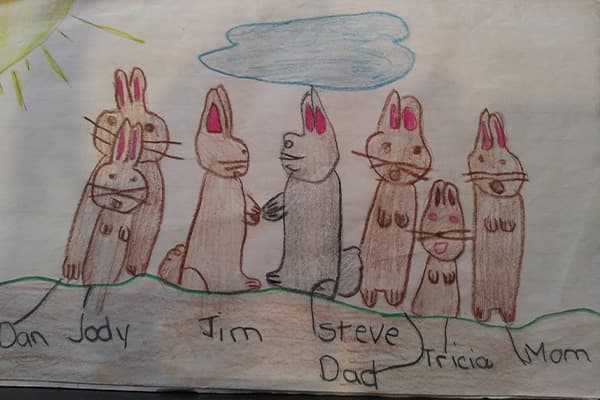
I started writing when I was five with my first epic novel, The Rabbit Family — handwritten, self-illustrated and starring my actual family as rabbits.
It was never formally published, but the single copy did make appearances at the local school, grocery store, bowling alley and bridge club meetings, courtesy of an enthusiastic mother and her large purse.
I am still grateful that my family let me develop my imagination without too much side-eye. Looking back, I realise that probably took some effort.
That early mix of storytelling, curiosity, humour, family and permission to be a little odd has followed me through pretty much everything I have made since.
Life taught me a lot before any of this had a name.
My career has never followed a tidy line either.
I was a caregiver to my mom while she lived with cancer. When she died, I was twenty-four, and I stepped into her role in our family restaurant. Life moved on because life does, even when you are nowhere near ready for it.
Later, my work took me into rehabilitation and education. I became a Rehab Therapist specialising in education and life skills, working primarily with children and young adults living with the effects of acquired brain injuries, behavioural challenges and physical impairments.
That work brought me into people’s real lives — not just the neat version that fits into an appointment. Recovery is not a straight line. Neither is going back to school, learning a routine again, or figuring out what the next step can realistically be when everything feels slower, harder or different than it used to.
Some days the work was about a skill. Some days it was about frustration, fatigue, a caregiver trying to hold a household together, or helping someone practise a small piece of independence until it felt possible. You learn, in that kind of work, to pay attention to the day in front of you — not the tidy version of progress that looks good on paper.
What I learned beside learners.
I have spent roughly twenty years working directly with learners in one form or another — tutoring, teaching, rehabilitation, education and life-skills support.
And over those years, I saw how easy it is for one difficult piece of learning to become something much bigger in a person’s mind.
A learner gets stuck on word problems and starts saying they are bad at math. Someone understands the book but cannot organise an essay and begins to think they are bad at English. A student needs an explanation repeated and decides everyone else must be smarter. Someone has a perfectly good idea in their head but cannot get the first sentence onto the page.
Those are not small things once they start changing how a person sees themselves.
I learned to look for the part underneath the frustration.
What is actually getting in the way? Is there a skill missing? Is the explanation not landing? Is the task too big to see where to begin? Does the learner need the idea broken apart? Do they need to hear it instead of read it? Do they need time to say the messy version before they can make sense of it?
I have seen what happens when the right piece finally clicks. The whole learner can look different — not because they suddenly became smarter, but because the obstacle became something they could understand and work with.
Not every learner who needs something different is struggling.
Some learners need another way in. Some need somewhere further to go.
I have also worked with learners who were ready to go further than the usual path gave them room to go — gifted learners, intensely curious learners, creative learners who wanted to pull an idea apart, follow the question beyond the assignment, make connections, or build something nobody had asked them to build.
Sometimes support means helping someone get over a barrier. Sometimes it means giving them enough room to stretch.
A learner should be able to fill a gap when they need to, but they should also be able to go deeper when they are ready.
I care just as much about the learner who wants the next question as I do about the learner who needs another explanation.
That matters to me in The Study Coach too. It should be able to help someone get unstuck, but it should also give a capable learner room to keep going — to explore an idea further, make connections, ask better questions and push beyond the point where the standard lesson might otherwise stop.
People remember how learning made them feel.
One of the things I care about most is dignity.
There is a particular vulnerability in having to say, “I don’t understand this.” Adults feel it too. So do very bright people. So do people who have succeeded at a hundred other things.
Being confused is not a character flaw. Needing something explained again is not laziness. Finding one way of learning difficult does not tell us everything about what someone is capable of.
I never want The Study Coach to make someone feel foolish for asking.
I want there to be room to ask again. Go backwards. Fill in the piece everyone assumed you already knew. Try a different explanation. Say, “That still makes no sense to me.”
Then I had a new question to wrestle with.
When AI became capable of carrying on genuinely useful conversations, I could see the possibility almost immediately.
A learner could have somewhere to ask at 9:30 at night when the assignment was due the next day. They could ask for the explanation again without worrying that they had already asked twice. They could get help finding a starting point when the tutor had gone home, the teacher was unavailable, or the parent at the kitchen table did not remember the math either.
That part was exciting.
But I was just as interested in the other question: what happens to the learning if the technology becomes too helpful?
I did not want to build a machine that could finish schoolwork faster.
I wanted to know whether AI could explain something another way, ask a useful question, help someone organise the mess in their head, practise a skill, think through a problem, or stay beside them long enough for them to find the next step — while the thinking and the accomplishment remained theirs.
Could we use AI to make meaningful learning support available to more people without taking the learning away from them?
That is the question behind The Study Coach.
Good help should not belong only to families who can afford a lot of it.
I also wanted the support to be affordable enough to reach ordinary families and ordinary learners.
One-to-one tutoring and professional support can be wonderful. I know that because I have spent years providing it.
It is also expensive, scheduled, limited by geography and limited by the number of hours another person can realistically be available.
The Study Coach is not meant to replace those people. I want it to make another layer of thoughtful support available in the spaces between them.
If technology can make genuinely useful learning help available to more people at a price an ordinary family can actually consider, I think that is worth trying very hard to get right.
I seem to keep building around the same questions.
Over the years I have written books, made learning resources, founded Authority Ed, built The Learning Library, worked on lifelong-learning and creative communities, and kept following ideas about how people learn, create, recover, change and keep becoming.
The projects look different from the outside, but I can see the thread now.
I am interested in what helps people keep going. What helps someone understand. What gives people another way in. What makes support feel human. And what becomes possible when people stop believing the door is closed to them.
And because nobody is only their work…
- I prefer to write in pencil.
- I love playing the drums. (Even though I don’t currently own a drum set.)
- I dance and sing whenever possible, especially in the car.
- I love building things with my hands, including walls I previously demolished.
- There is nothing quite like the crackle of a bonfire.
- I make a mean banana bread.
- I am sentimental as hell.
- I talk to rabbits and chipmunks and maintain that they understand me.
I’m still learning too.
I do not think there is a finish line where we finally know enough and become the completed version of ourselves.
We learn. We forget things. We change our minds. We come back to ideas years later. We discover something we wish we had understood sooner. We try things we are terrible at and, occasionally, keep going anyway.
That is part of being alive.
Curiosity should not belong only to people who find learning easy. Help should not belong only to people who can afford expensive support. And education should not have an expiration date.
Learning is for all of us, for as long as we’re here.
Learning isn’t just one stage of life. It’s the through-line.