
For Families
Help them become more independent — without leaving them alone.
The Study Coach gives learners somewhere to go when they are stuck, need another explanation, cannot figure out how to begin, or need help organising what they know. The learner keeps ownership of the work, while the family has another layer of support to draw on.
No credit card required.
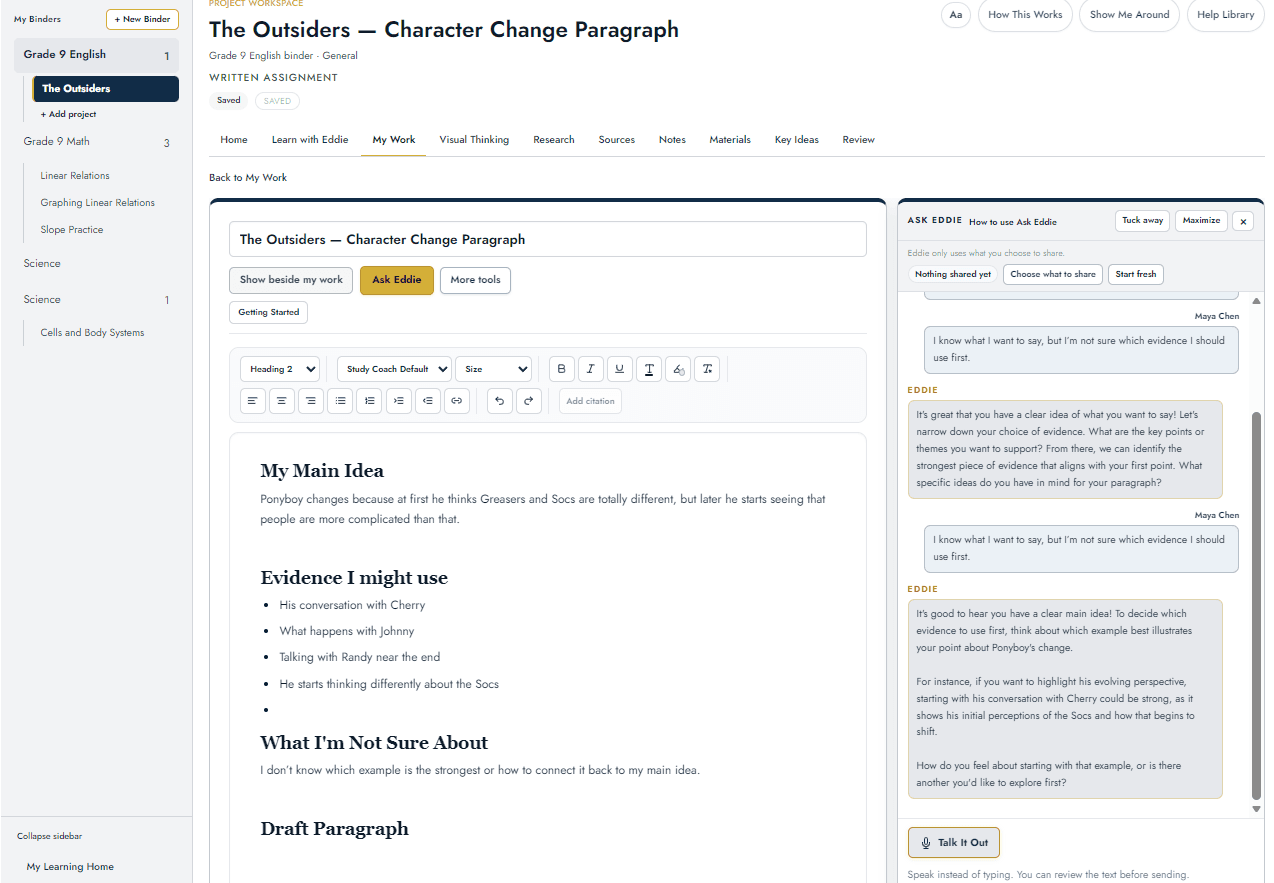
You do not have to become the homework department.
A learner can ask for another explanation, talk through an idea, check a step, or figure out where to begin before every stuck moment has to become a family problem to solve.
That can take some of the instructional pressure off parents who may not remember the algebra, grammar rule, citation style or science concept themselves. The learner has another place to try first.
The same is true for French homework. A student in Core French or French Immersion can practise the words from class and bring a worksheet to Eddie. French Language Practice is included with the membership.
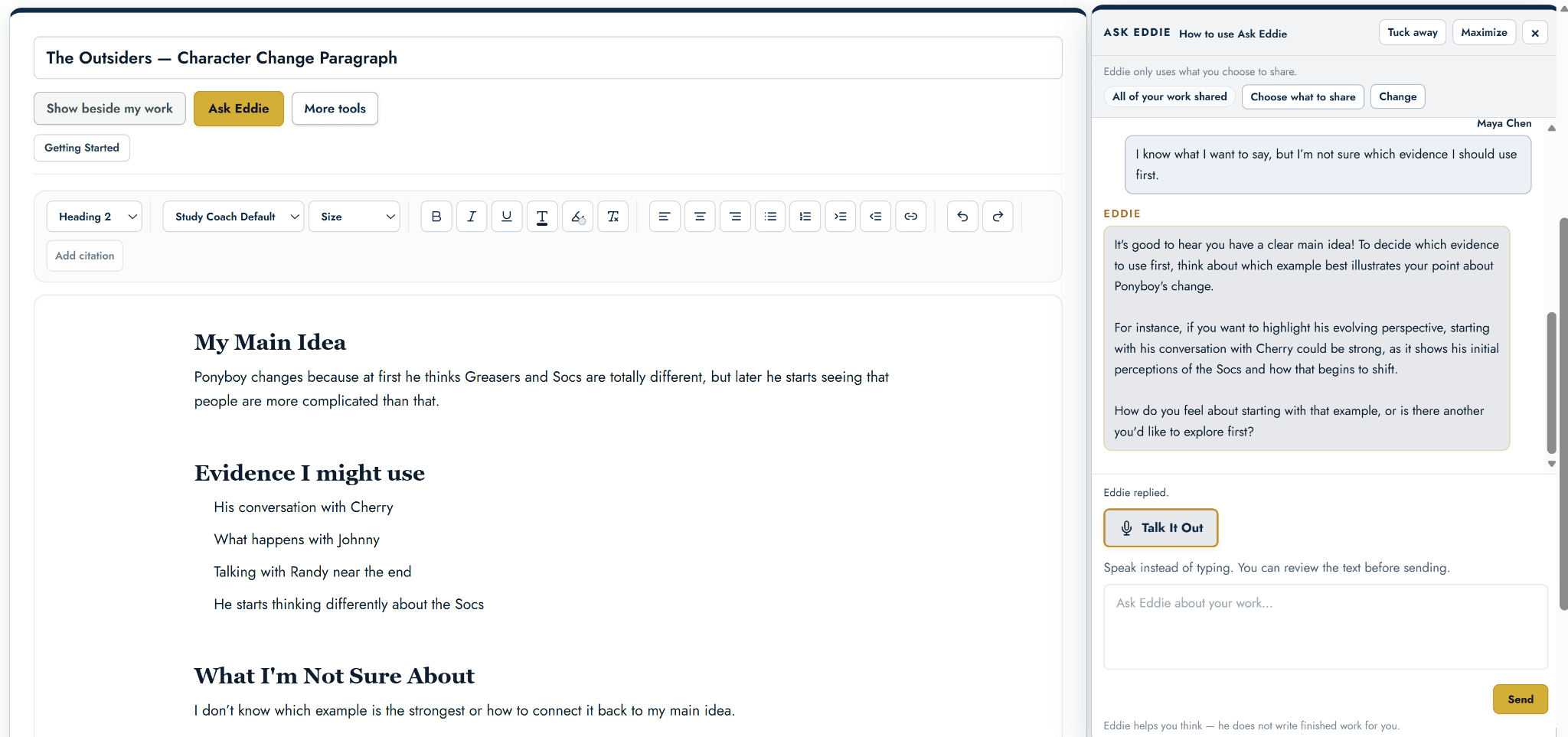
The learner works here. Eddie coaches here.
Eddie can explain, ask questions, help organise ideas, check reasoning, or help the learner decide what to try next. The learner still writes, chooses, calculates, revises and decides what belongs in the work.
Good support should also help the learner become more able to handle the next difficult moment themselves — knowing how to begin, what question to ask, what to check, and when asking for help is the right next step.
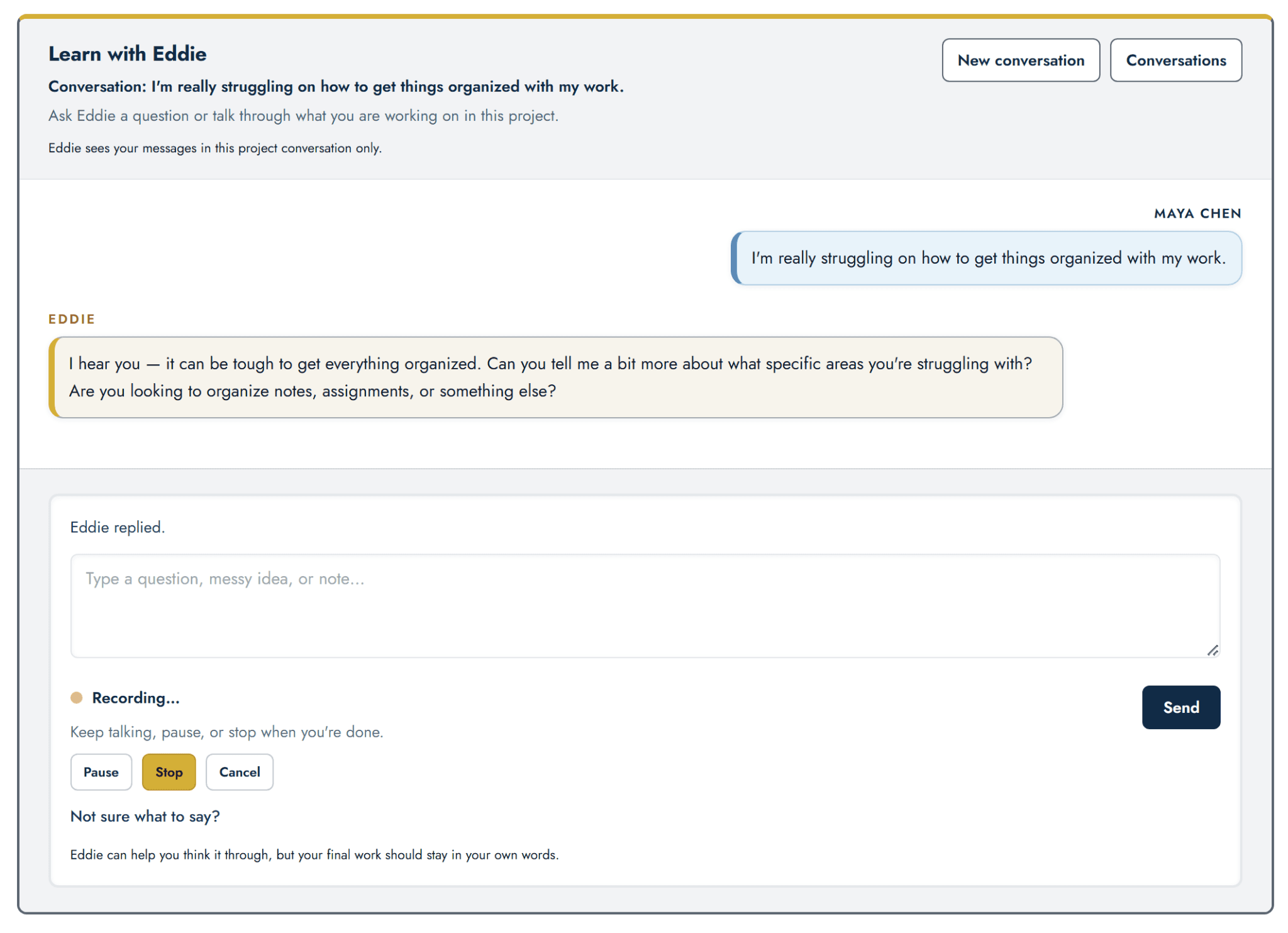
Sometimes the way in needs to change.
Some learners need to say the messy version before they can write it. Talk It Out lets them use the microphone, turn speech into editable text, and decide what they want to send.
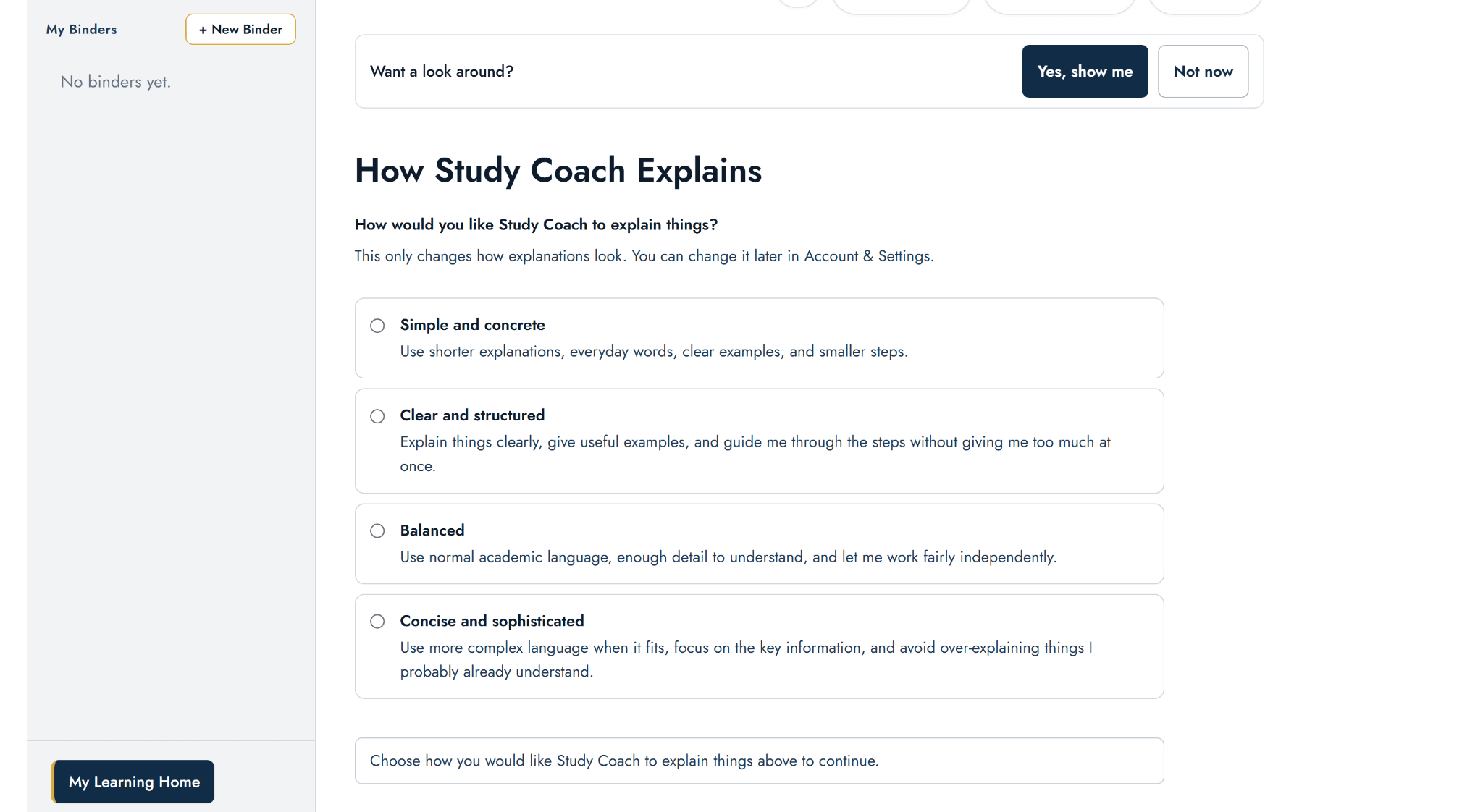
Learners can also choose how explanations are presented — Simple and concrete, Clear and structured, Balanced, or Concise and sophisticated. Those choices change the way support is presented, not what the learner is considered capable of learning.
Eddie can speak responses aloud, and many Learn lessons include read-aloud support.
Help the learner see what is happening too.
Sometimes a learner knows they are stuck without knowing why. Insights can help make patterns in their own work easier to notice — where something keeps getting difficult, where a strategy seems to be helping, what may be worth revisiting, and where progress is beginning to appear.
The goal is not to tell the learner who they are or assign them a fixed label. It is to give them a clearer picture of their own learning so they can make better decisions about what to try next and when to ask for help. Needing help with one part of learning does not define the learner.
And give the people supporting them a better starting point.
Parents and other trusted supporters may also benefit from appropriate, bounded insight into how the learner is doing. That can help an adult understand where support may be useful, notice patterns that are difficult for the learner to explain, and ask better questions.
The supporter view should help the adult support the learner — not replace the learner’s own understanding of their progress.
A parent may know that a learner is frustrated, avoiding a subject, or repeatedly asking for help without knowing exactly where the difficulty begins. Support View can help turn a vague concern into a more useful question by looking at ordinary shared learning activity — without opening the learner’s private workspace, chats, files or Insights.
Take a clearer picture into the conversation.
Sometimes it helps to have something concrete in front of you before a school meeting, tutoring session or other conversation about learning.
A learner can print their own Insights to help them talk about patterns they are noticing in their learning. A trusted supporter can also print the bounded Support View available to them.
These are different views, designed for different purposes. Neither is a diagnosis or professional assessment. They can simply give the learner and the people around them a clearer starting point for a useful conversation.
A learner may seem to “hate math,” for example, while their work repeatedly suggests that the calculations themselves are manageable and the difficulty tends to appear when a word problem has to be translated into a mathematical setup.
That does not diagnose the reason. It gives everyone a more useful question to explore.
- remember what you wanted to ask
- describe patterns more specifically
- bring examples from observed learning rather than relying only on memory or frustration
- ask a teacher, tutor, therapist or other professional better questions
- notice whether the same difficulty appears in more than one setting
- recognise progress as well as difficulty
Support does not have to come from only one person.
Through Support Circle, trusted adults can be connected around the learner. That might include a parent or another person who plays a meaningful role in their learning.
The aim is to let the learner have more than one person in their corner, while giving those supporters enough useful context to help well.
When sharing is turned on, a supporter can open a Support View — a calm, bounded summary of what has been shared. It is not the learner’s private work, chats or files.
Supporter insight is meant to support the learner’s own understanding and independence — not turn their learning into something being watched from the outside.
Useful insight, not a label.
Better information can help the people around the learner too.
Teachers, tutors, therapists, parents and other trusted adults bring judgement, relationships and context that software cannot replace.
The Study Coach can help between those human moments and can give the people supporting the learner a clearer starting point for understanding where help may be useful.

Built by someone who has spent years beside learners.
The Study Coach grew from Trish Faber’s years of working directly with learners as an educator, tutor and rehab therapist. That experience shaped an approach built around dignity, practical support, learner ownership and the belief that a difficulty in one area should never become a definition of the whole learner.
Read the Founder StoryThoughtful support at a price families can actually consider.
The Study Coach is CAD $24.99/month for one learner. Additional learners can be added for CAD $9.99/month each, up to 5 active learners total.
New learners can try The Study Coach for 14 days free, with no credit card required.
Pause is planned at CAD $5.00/month and is not yet available to activate.
Give them another place to try first.
Support the learner without having to become the answer to every question — and stay better informed about where your support may actually help.
No credit card required.