
Visual Thinking
Give the idea a shape you can see.
Some ideas become easier to understand when their relationships, sequence or differences are visible. Visual Thinking gives learners structured ways to organise those ideas and return to them later.
No credit card required.
Four ways to make the thinking visible.
Visual Thinking is not a blank drawing board. Each form gives the idea a structure that matches the kind of thinking the learner needs to do.
Mind Map
Useful for ideas that branch and connect.
Flowchart
Useful for sequence, process and decisions.
Timeline
Useful for events, change and chronology.
Venn Diagram
Useful for comparison and overlap.
Choose the structure that fits the thinking.
The Study Coach helps learners understand when and why each visual form is useful — so they can choose a mind map, a flowchart, a timeline or a Venn diagram for a reason, rather than starting from a blank canvas and hoping a shape appears.
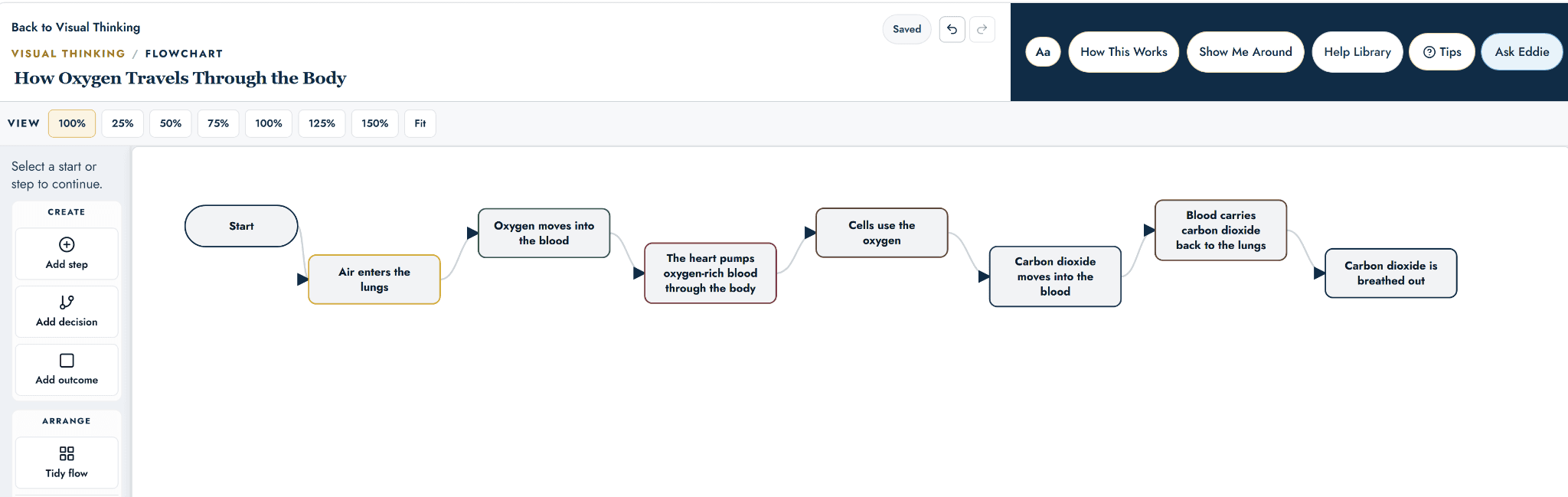
Turn a process into something you can follow.
The flowchart here follows how oxygen travels through the body: from the air, into the blood, through the heart, and into the cells that use it. Each step stays in order, so the learner can see the process as a path rather than a paragraph they have to hold in their head.
Ask about the picture, keep the pen.
Eddie can help the learner think through a visual when they ask — what a step means, what might come next, or whether two ideas belong together. Eddie does not silently change the diagram.
See the idea another way.
Give the thinking a structure you can look at, return to, and keep working with.
No credit card required.